

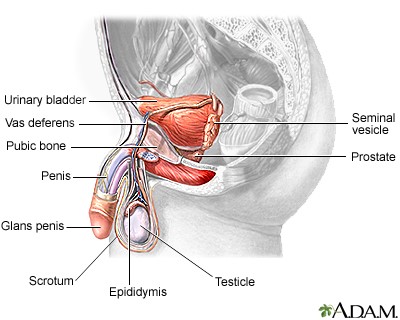
Testicles, or testes, are the part of the reproductive system in men and people assigned male at birth (AMAB) that makes sperm and hormones. They’re located outside your body.

The testicles make sperm and sex hormones, particularly testosterone.
Testicles are about two degrees Celsius lower in temperature than the rest of your body. Cooler temperatures are better for making sperm, a process called spermatogenesis. In each of the testes, the process happens in tubes called seminiferous tubules. There are a surprising number of tubes in each testis — about 700.
It takes about 74 days for sperm cells to mature. The immature cells get the blood and nutrients they need in the tubules. From there, they’re pushed along to the epididymis, another type of tube that runs along the back side of your testicle. The epididymis connects to the vas deferens, which is the tube that lets sperm leave your body through your penis.
Your testicles are located underneath your penis. They’re enclosed in a pouch of skin called the scrotum. Generally, you’ll have one testicle to the right and one testicle to the left of your penis.
Your testicles are connected to the inside of your body by a cord called the spermatic cord. Each cord contains nerves and blood vessels. The cords also contain the vas deferens, which are the tubes that move sperm to your penis, so it can leave your body in semen.
There’s no exact size for testicles. In fact, one of your testicles may be a little bit bigger than the other one. One testicle might be a little lower than the other. An adult testicle may range from half an inch (15 mL) to 1.5 inches (35 mL) or more. One comparison says the normal range goes from the size of a bird egg to the size of a small chicken egg.
Many testicle-related diseases are found in children, but not all. Here are some conditions that could affect your testicles:
Hypogonadism: Your testicles don’t produce enough of the hormones you need.
Klinefelter syndrome: This genetic condition happens when a person is born with two copies of the X chromosome and one copy of the Y chromosome.
Infertility: This refers to being unable to impregnate a partner. Your testicles may not produce any — or enough — sperm, or they might not be able to release the sperm.
Cryptorchidism: This condition, also called undescended testicles, refers to testicles that don’t drop into your scrotum when they should.
Epididymitis: This condition refers to an inflammation of the epididymis.
Spermatocele: This is another name for a cyst that grows above or behind a testis.
Testicular torsion: This medical emergency happens when a testis becomes twisted, and the blood supply is cut off. You need to get help right away.
Testicular cancer: This condition is the most common cancer in men and people assigned male at birth (AMAB) who are between the ages of 20 and 35 years old.
Your testicles can be damaged by physical trauma, including motor vehicle accidents, falls or fights.
Testicle pain is discomfort in one or both testicles. The pain can spread into the lower abdomen.
The testicles are very sensitive. Even a minor injury can cause pain. In some conditions, abdominal pain may occur before testicle pain.
Common causes of testicle pain include:
- Infection or swelling of the sperm ducts (epididymitis) or testicles (orchitis).
- Twisting of the testicles that can cut off the blood supply (testicular torsion). It is most common in young men between 10 and 20 years old. It is a medical emergency that needs to be treated as soon as possible. If surgery is performed within 4 hours, most testicles can be saved.
Mild pain may be caused by fluid collection in the scrotum, such as:
- Enlarged veins in the scrotum (varicocele).
- Cyst in the epididymis that often contains dead sperm cells (spermatocele).
- Fluid surrounding the testicle (hydrocele).
- Pain in the testicles may also be caused by a hernia or kidney stone.
- Testicular canceris almost always painless. But any testicle lump should be checked out by your health care provider, whether or not there is pain.
Sudden, severe testicle pain needs immediate medical care.
Consult the doctor right away or go to an emergency room if:
- Your pain is severe or sudden.
- You have had an injury or trauma to the scrotum, and you still have pain or swelling after 1 hour.
- Your pain is accompanied by nausea or vomiting.
Also consult your doctor right away if:
- You feel a lump in the scrotum.
- You have a fever.
- Your scrotum is warm, tender to the touch, or red.
- You have been in contact with someone who has the mumps.