



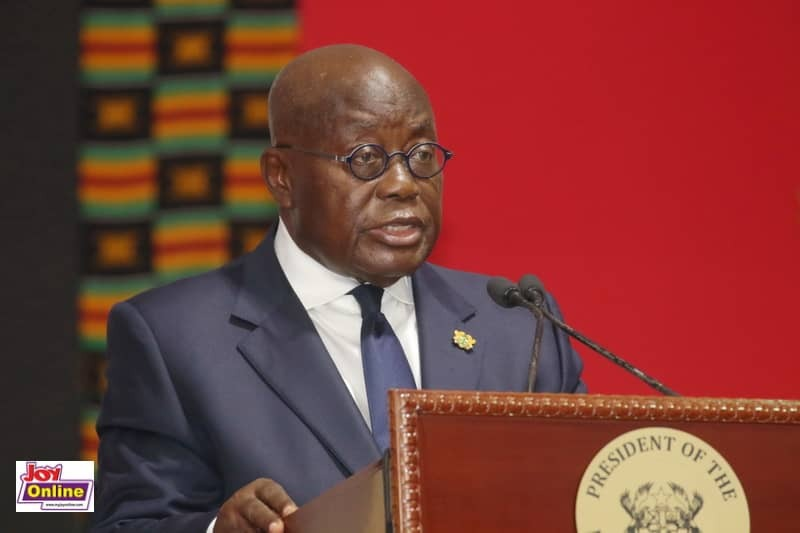
Mr Speaker,

It is always good to be back in Parliament, and to discharge the duty, in accordance with Article 67 of the Constitution, of delivering to the House a Message on the State of the Nation. I am particularly delighted as this Message is the first of my 2nd term, the validity of which was unanimously upheld last week in a well-reasoned and excellent ruling by a seven-member panel of the Supreme Court, presided over by the Chief Justice, on 4th March 2021.
In accordance with protocol and convention, it is good to see that First Lady Rebecca Akufo-Addo, Vice President Mahamudu Bawumia, Second Lady Samira Bawumia, Spouse of Mr. Speaker, Chief Justice Anin Yeboah, and Justices of the Supreme Court, re-elected Chairperson Nana Otuo Siriboe II, and Members of the Council of State, the new Chief of Defence Staff Vice Admiral Seth Amoamah, the Inspector General of Police, Mr. James Oppong-Boanuh, and Service Chiefs, are all present, as are the Dean and Members of the Diplomatic Corps.
Let me use this opportunity to congratulate, once again, the Speaker of Parliament, Rt. Hon. Alban Kingsford Sumana Bagbin, on becoming Speaker of the 8th Parliament. His has been a distinguished career, having entered the 1st Parliament of the 4th Republic in 1993, and I came to meet him in the 2nd Parliament in 1997. He has been Majority Leader, Minister of State, one of the “three wisemen” in a previous Government, 2nd Deputy Speaker of Parliament, and now finds himself in this elevated position of being the third most important person in the governance structure of our country. It is wholly appropriate that, at such a critical period in the history of our country, my senior in Parliament and I should work together for the wellbeing of the Ghanaian people.
Mr. Speaker, I wish you well in the discharge of the duties of this high office.
Mr. Speaker, in 2017, I was here for the first time as President of the Republic, having won the election of 2016, and having inherited a faltering economy and an expectant people. Between that time and 2020, I sought to deliver on the mandate reposed on me and my party, the New Patriotic Party, and gain, once again, the confidence of the Ghanaian people. It was by no means a straight-forward task. We were able to deliver on most of our 2016 promises. In spite of the considerable challenges we confronted, and the setbacks we encountered, we were confident our record in office would put us in good stead before the electorate, and earn us a second term in office, which it did.
It means that the reason for which the Ghanaian people went to the polls on 7th December, i.e to seek an improvement in their living standards and the rapid transformation of the economy, must continue in earnest. It means that the clarion call of “Four More for Nana and the NPP to do more for you” must be realised, and I intend to do so.
The commencement of this process has been facilitated by members of this House, and I am thankful to you for enabling Government to be duly constituted. The expeditious and thorough manner in which my Ministers were scrutinised by the Appointments Committee, and the approval by the full House of each of the twenty-nine (29) substantive Ministers, for me, was an indication of the collective determination of both sides of the House, with mutual regard for each other, to work together for the good of the country. This is what the Ghanaian people demand from us by insisting on virtual parity in the House between the two major parties of our country. The realisation of the Ghana Project, and not the attainment of narrow partisan interests, must be the guiding principle of the business to be conducted in the House.
As President of the Republic, I give my firm commitment to this end, and I assure Mr Speaker and the Legislature of the co-operation of the Executive in this endeavour. As I indicated in my acceptance speech on the night of 9th December 2020, now is the time for each and every one of us, irrespective of our political affiliations, to unite, join hands, stand shoulder-to-shoulder, and work hard to place Ghana where she deserves to be.
Mr. Speaker, in the face of a global pandemic that has ravaged lives and livelihoods in all parts of the world, we cannot afford to pursue interests that will leave our nation and its citizens the poorer for it. COVID-19 has impacted heavily on economic activities, created uncertainty, weakened global growth conditions, whilst putting undue strain on already weak and fragile health systems, particularly in developing countries.
Mr. Speaker, between 2017 and the first quarter of 2020, we had made considerable gains in the management of the national economy, where we witnessed annual average GDP growth of seven percent (7%), single digit inflation, reduced fiscal deficits with three consecutive years of primary surpluses, a relatively stable exchange rate, a significant improvement in the current account with three consecutive years of trade surpluses, strong foreign exchange reserve buffers, markedly reduced lending rates, and appreciable job creation.
According to the COVID-19 Business Tracker survey, conducted by the Ghana Statistical Service, in collaboration with the United Nations Development Programme (UNDP) and the World Bank, the COVID-19 pandemic has led to job losses, with many Ghanaian businesses and firms being forced to cut costs by reducing staff hours, cutting wages, and, in some cases, laying off workers. This survey, again, showed that about seven hundred and seventy thousand (770,000) workers had their wages reduced, and about forty-two thousand (42,000) employees were laid off during the three-week partial lockdown imposed on the Greater Accra and Greater Kumasi Metropolitan Areas and their contiguous districts, Tema and Kasoa. Government, however, succeeded in protecting the jobs and incomes of all public sector workers.
Indeed, the cost of COVID-19 has been enormous. Our overall economic growth rate for 2020 was revised downwards from 6.8% to 0.9%. The non-oil economy was also revised from 6.7% to 1.6%. Revenue shortfall was estimated at GH¢13.5 billion, with additional expenditures related to stemming the tide of COVID-19 estimated at GH¢11.8 billion, with the combined effect amounting to GH¢25.3 billion, or 6.6% of GDP. The resultant fiscal deficit for 2020 was, thus, revised from 4.7% of GDP to 11.4% of GDP. This was done to reflect the impact of the pandemic. The fiscal responsibility rule of keeping a deficit within a threshold of 5% of GDP and a positive primary balance for every year was suspended in 2020 to enable fiscal operations accommodate the impact of the pandemic.
I indicated at the time that we know what to do to bring the economy back to life, what we do not know how to do is to bring people back to life. That is why Government did not hesitate to institute measures to protect the lives and livelihoods of Ghanaians, even if it was to the temporary detriment of our much sought-after fiscal stability.
The formulation and implementation of the COVID-19 preparedness and response plan, tracing, testing, treatment, waiver of personal income tax and provision of an additional fifty percent (50%) basic salary allowance to healthcare workers, expanding the capacities of laboratories to increase COVID-19 testing, establishment of isolation centres in all regions and districts, fumigation of markets and schools, provision of food packages and hot meals for residents in areas affected by the partial lockdown, provision of free water for all households, provision of free electricity for lifeline consumers and a fifty percent (50%) discount for all other consumers, reduction in the Communication Service Tax (CST) from nine percent (9%) to five percent (5%), the institution of a seven hundred and fifty million cedi (GH¢750 million) loan facility for micro, small and medium enterprises through the CAPBUS Initiative, and the provision of a two billion cedi (GH¢2 billion) guarantee facility to support large businesses, such as schools and pharmaceutical companies, are amongst the several measures put in place by Government to cushion Ghanaians from the impact of the pandemic.
Support has also been forthcoming from the Bank of Ghana, under its brilliant leadership, which has lowered the Monetary Policy Rate by one hundred and fifty (150) basis points to 14.5 percent, reduced the Primary Reserve Requirement from ten percent (10%) to eight percent (8%), reduced the Capital Adequacy Requirement from thirteen percent (13%) to eleven-point five percent (11.5%), and reduced interest rates based on the Ghana Reference Rate by two hundred (200) basis points.
The Ghana Revenue Authority has also extended the dates for filing of taxes from four (4) months to six (6) months after the end of the basis year, issued a waiver on VAT, National Health Insurance Levy and GETFund Levy on donations of equipment and goods for fighting the pandemic, waived income taxes on Third-Tier Pension withdrawals, and permitted the deduction of contributions and donations towards COVID-19 as allowable expense for tax purposes.
Mr. Speaker, my Government found the resources to cushion the impact of the pandemic because we are good managers of the economy, and we are good protectors of the public purse.
Mr. Speaker, the pandemic has exposed the need to expedite the process of moving Ghana to a situation beyond aid. That is why Government has developed and is currently implementing the one hundred-billion-cedi (GH¢100 billion) Ghana CARES ‘Obaatampa’ Programme to transform, revitalise and modernise our economy, and return it to high and sustained growth for the next three years. The key projects under the CARES Programme include:
- supporting commercial farming and attracting educated youth into commercial farming;
- building the country’s light manufacturing sector;
- developing engineering/machine tools and ICT/digital economy industries;
- fast tracking digitalisation;
- developing Ghana’s housing & construction industry;
- establishing Ghana as a Regional Hub;
- reviewing and optimising the implementation of Government flagships and key programmes; and
- creating jobs for young people, and expanding opportunities for the vulnerable in society, including persons with disabilities.
The establishment of the National Development Bank, under the Ghana CARES programme, is expected to provide support to businesses in Ghana. Government expects economic activity, which has already picked up, to do so even further, following the ongoing vaccination exercise, and the easing of restrictions put in place to curb the effects of the disease. We expect GDP growth to rebound strongly this year to nearly five percent (5%), above the IMF’s 2021 January projection of 3.2% growth for Sub-Saharan Africa for 2021.
The medium-term outlook supported by the implementation of the Ghana CARES Programme is bright. We are confident that, together, we will emerge from the COVID-19 pandemic with a stronger and more resilient economy.
Mr. Speaker, if we are to oversee the rebirth and growth of our economy, our people must be healthy, and not succumb to COVID-19. On 24th February, Government secured the first batch of vaccine doses from the COVAX Facility. The vaccination campaign is currently ongoing, with two hundred and sixty-two thousand, three hundred and thirty-five (262,335) number of Ghanaians receiving the first dose of the vaccines as at 10:30am this morning. The target is to vaccinate twenty million Ghanaians, and Government is working hard towards realising this goal. We remain on course to taking delivery of some seventeen million, six hundred thousand vaccine doses by June, with more to come in the course of the year.
I want to urge Members of the House to lend their voices to the public education campaign currently ongoing with regards to the vaccination programme. The vaccine, together with strict compliance with the safety protocols, is what will allow us to open up our country again, and embark on the quest to restore normalcy to our lives and livelihoods.
Government is also mindful of a problem associated with vaccinations, and that is how to dispose of used PPEs, vials, needles and syringes that are being used in the vaccination exercise. Government is collaborating with the private sector to establish fourteen (14) medical waste treatment facilities across the country to help address, once and for all, the saf