



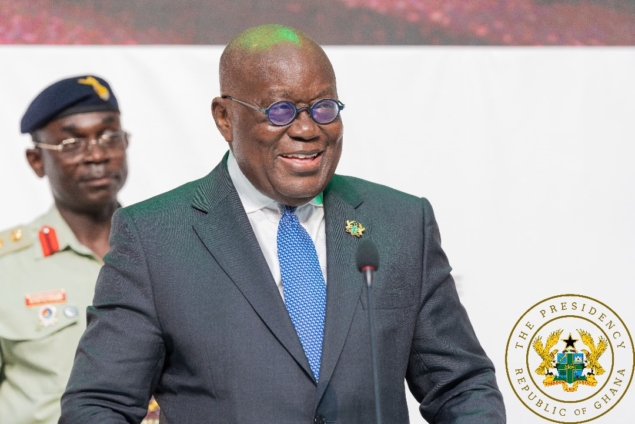
Fellow Ghanaians, let me start by welcoming our special guest of honour, the redoubtable President of our western neighbour, the Republic of Cote d’Ivoire, His Excellency Alassane Ouattara, to the formal celebrations of the 67th anniversary of Ghana’s independence.

I thank the children from across the country for their excellent march. I thank the cultural troupes from across the country on their magnificent display, which has showcased the best of Ghanaian culture. I thank the officers, men and women of the Ghana Armed Forces, the Police Service and the other Security Services for their display of order, pomp and ceremony. And I thank them all for their willingness to put their lives on the line to secure the safety of our nation, the peace of our society, and the sanctity of our property.
I am sure it is not too late for us to extend warm congratulations to you, Monsieur le President, and your country on staging a most successful AFCON, and the dramatic exploits of your national team that ended in your winning the continental competition, and being crowned African football champions. Congratulations to you, to Cote d’Ivoire, and to the Elephants. As we all saw, the year begun with the victory of the Elephants.
I am afraid that, over here in Ghana, this is a competition we would much rather not remember or even talk about, but Ghana and Cote d’Ivoire are good neighbours, and we cannot begrudge your excellent performance, and learn from the many lessons that AFCON 2023 has to teach.
Welcome to Ghana, Monsieur le President, and thank you very much for honouring our invitation, and joining us for our independence anniversary celebrations. Ghana is your home, the relationship between our countries is as it should be, for we share a common boundary, a common history and a common culture, including common languages, and as we would both say, akwaaba. We are greatly honoured by your presence, and we pay homage to your distinguished leadership, pre-eminent in the annals of contemporary Africa, which has brought your country back from the chaos of a painful civil war and its aftermath, to the stability and prosperity that have been traditionally associated with Cote d’Ivoire.
The strong bonds of friendship and co-operation that have existed during our respective tenures of office are evidenced by two key developments. First is the Agreement for Strategic Partnership that was entered into by President Ouattara and I, on 17th October 2017, during my first year at the presidency, which has paid off, especially in the cocoa sector, by enabling our two countries to co-ordinate our policies over cocoa, of which we are the world’s biggest producers, accounting jointly for some sixtyfive percent (65%) of global output. This has been of considerable benefit to our respective farmers, who have received the highest price per bag of cocoa in our respective histories. The other is the mature manner in which the maritime border dispute between our two countries was settled by the Maritime Court. The elevated stance of statesmanship shown by President Ouattara ensured that its result, in Ghana’s favour, was peacefully accommodated by Cote d’Ivoire.
My dear compatriots, fellow Ghanaians, the theme chosen for this year’s Independence Day celebrations is “OUR DEMOCRACY, OUR PRIDE”, and I welcome you all to Koforidua, the capital of the Eastern Region, which is hosting the celebrations this year. The decision to rotate the scene of the national celebrations around the country, instead of staging them only in Accra, the national capital, has, certainly, turned out to be a welcome, nation-building exercise, that helps to focus attention on a different region every year, and, at the same time, rallies the nation together.
Our host this year, the Eastern Region, was very much at the centre of the independence struggle of our country – it is home to three (3) members of the BIG SIX of the United Gold Coast Convention (UGCC), the acknowledged founders of our nation, Joseph Boakye Danquah, Edward Akufo-Addo and William Ofori-Atta. Their love of politics would seem to have continued into succeeding generations with the son of one of them being the current president of our country. The other members of the Big Six were Emmanuel Obetsebi-Lamptey, Ebenezer Ako Adjei and Kwame Nkrumah, who, together with George Alfred ‘Paa’ Grant, R.S Blay, Cobbina Kessie, Francis Awonor Williams, Nii Kwabena Bonney, Boycott hene, and others, were the successors of the early generation of nationalists, such as the members of the Aborigines Rights Protection Society. Their membership included Jacob Sey, George Moor, Joseph Casely Hayford, John Mensah Sarbah, W.E.G (Kobina) Sekyi, J.W. de Graft-Johnson, J.P Brown and others, who protected our lands from the grasp of the greedy imperialists, and who initiated the first phase of our struggle for national independence.
On such a day, we must also remember the contribution of Yaa Asantewaa, James Aggrey Kwegyir, Sergeant Adjetey, Corporal Attipoe, Private Odartey Lamptey, V.B Annan, Jimmy Quist-Therson, Mabel Dove, Akua Shorshorshor, Dede Ashikinshan, Komla Agbeli Gbedemah, Kojo Botsio, Kofi Baako, Krobo Edusei, Nancy Tsiboe, Mumuni Bawumia, S.D. Dombo, Kofi Abrefa Busia, Joe Appiah, Victor Owusu, R.R. Amponsah, Baffuor Osei Akoto, Modesto Apaloo, S.G Antor, Yakubu Tali, Ephraim Amu, to the liberation of our country, and to the birth of our democracy. The work of all these great patriots culminated in the immemorial words of our nation’s first leader, Kwame Nkrumah, when he stated, on the eve of 6th March 1957, that “at long last, the battle has ended. Ghana, your
beloved country is free, free forever.”
Today, the Eastern Region is, of course, not the geographic east of Ghana, but it retains the nomenclature from the colonial days, when it was the eastern border of what was the Gold Coast colony. This Region is the most heterogeneous in our country and a microcosm of Ghana, and home to the most diverse of our peoples. Over the centuries, the Region has attracted citizens from all parts of the country and beyond, who come to work and find a welcome and lasting home. The attraction is obviously the abundant mineral resources and the rich and fertile soils. It is, after all, only a few kilometres from here that the first cocoa farm in the country was planted in 1895, some one hundred and twenty-nine (129) years ago, and from there the planting of cocoa spread to other parts of the country, and became our leading cash crop. Indeed, Tetteh Quarshie, an indigene of Mampong Akuapem, here in the Eastern Region, brought back, in the late 19th century, the cocoa pod from Fernando Po, now Bioko, in Equatorial Guinea, an act which led him and others to establish our nation’s first commercial cocoa farms here in the Eastern Region.
It is noteworthy that the hills and mountains of the Region, and the relatively cooler weather, made it attractive to the European colonialists and missionaries, whose footprints remain around the Region. It is not surprising, therefore, that the Region is home to many educational institutions, including the first middle school and first training college in the country – both in Akropong. The old and beautiful stone churches along the scenic mountain road of the Akuapem hills remain an attraction. It must surely be, as a result of Akuapem Twi being the first Ghanaian language to have been written, that the culture and mannerisms of the people became adopted in the formal recognition and rendition of Ghanaian culture. When we say it is part of Ghanaian culture to be respectful in conversations, I daresay the source must be the legendary Akuapem insistence that even an insult must be preceded with a PLEASE. They remain the repository of the rules of proper behaviour.
It is here, in the Eastern Region, that we find the beautiful and intricate beadworks that are defining features of Ghanaian jewellery. The Krobos are the masters of the ancient art, and have modernised it to make beads attractive not only to the old, but also to the present generation as well.
The Eastern Region is also the home of the Kwahus, Ghana’s unquestioned leading entrepreneurs, and an example to all of us of what private enterprise can achieve.
It is, furthermore, the home of the Akyems, the single biggest ethnic group in the Region, who founded one of the most ancient states of Ghana’s history, with an unbroken record of chiefly government, dating from the 14th century till today.
I have mentioned some specific groups that make up the Eastern Region, but, as I stated earlier, it is a Region where the whole of Ghana merges into a melting pot and lives in harmony, and different groups feed on the strengths of each other for the good of the whole. This is the same scenario that is played on the national scale, where different people have come together to form the Ghanaian nation and a national identity for the past sixty-seven (67) years.
Fellow Ghanaians, we have good reason to choose as our theme and to celebrate OUR DEMOCRACY, OUR PRIDE at the 67th anniversary of our independence.
We are a democratic nation, and not every country can make such a claim. It is important to note that the democratic system of government we have today was not given to us at independence; more than a hundred years (100) of British rule had not prepared us in any way for democracy, there is nothing democratic about colonial rule, and, whatever we have today, we have worked out for ourselves.
All the defining elements of a democracy, that are part of our governance architecture today, we have had to fabricate ourselves. Everything we know about elections today, and we know quite a bit, we have learnt through hard practice, and, in the past thirty-one (31) years, we have been stable.
We have not got a perfect system, but, every time we have had elections during this 4th Republic, it has been an improvement on the previous occasion.
We still have a lot more to learn especially when it comes to the tolerance of opposing views. But we also know that we dare not relapse, as there are many examples of countries that have disintegrated into chaos as a result of disputed elections.
We know that technology is a useful tool that we must embrace to make the electoral process more transparent, but we are very much aware that technology also now makes it possible and easier for the deliberate manipulation and propagation of falsehood to influence public opinion.
When it comes to free speech and a vigorous media as indicators of a working democracy, I believe we can say we are doing well. There is no danger of dissenting voices not being heard on any subject, even though we still have more work to do on elevating the quality of public discourse.
We take our disputes to the courts for resolution, and the judicial system operates within agreed and acceptable rules.
When we look around our neighbourhood, we might be tempted to think that our work is done, but we, Ghanaians, have never been known to settle for mediocrity. We aim for the best in every field. We should compare ourselves with the best that there is, and not settle for anything less. For as long as there is poverty and injustice anywhere in Ghana, our work is not done.
On a day like this, we should pay homage, of course, as I have done, to our forebears and the elders who fought for independence, and worked through the years to establish all that we have to be proud of today, but our attitude should always be that there are better days ahead, and work towards that, instead of yearning for some bygone good old days.
The greatest challenge remains the provision of good quality education to all of Ghana’s children and young people. We have a lot to be proud of, but we have more work to do. I am happy that, through the implementation of the Free Senior High School policy, we are removing financial barriers to education, unlocking the potential of thousan