


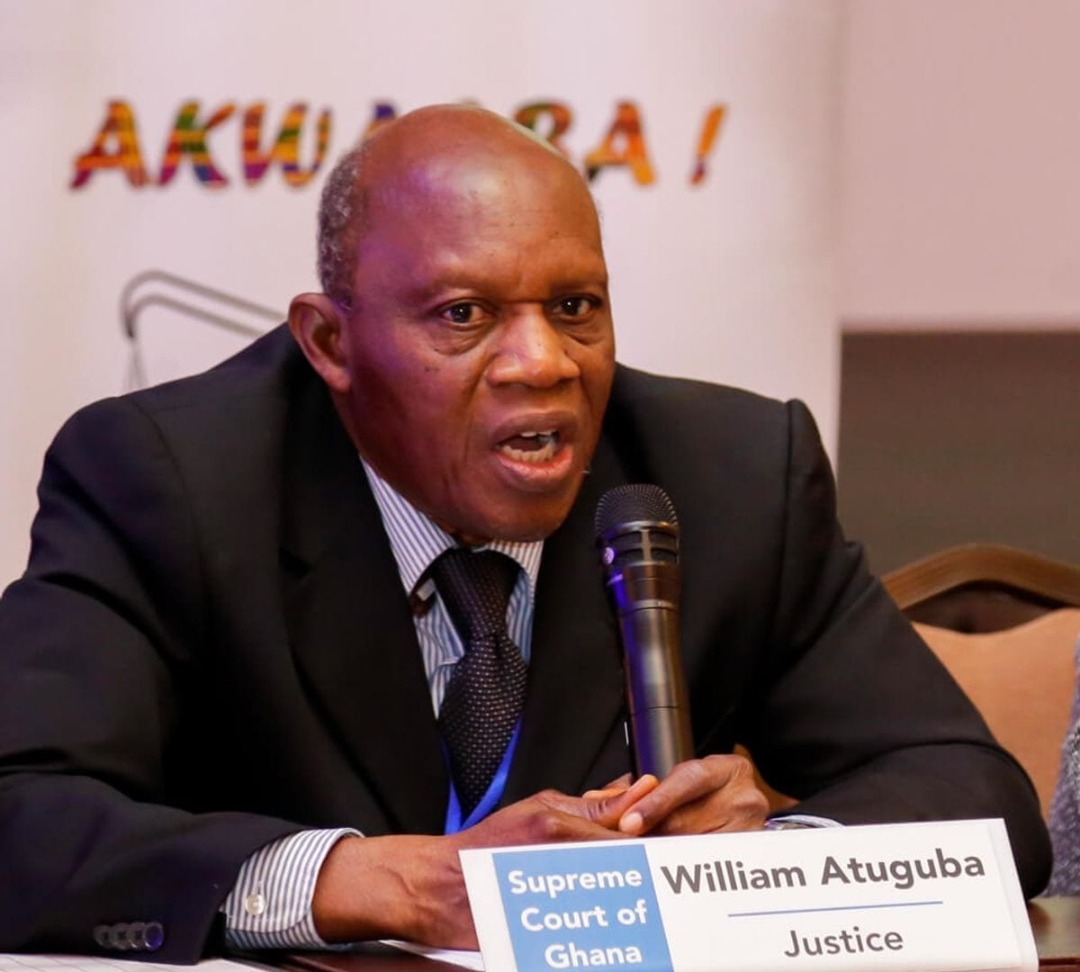


Mr. Chairman, distinguished invited guests, media, ladies and gentlemen, let me appreciate the organizers for putting up this lecture.

Introduction
I feel highly honoured but down spirited by this invitation to lead this lecture today. Mr. Chairman, on the eve of our independence, our country was consecrated to the sacred and Immaculate hearts of our Lord Jesus Christ and our Mother the Blessed Virgin Mary.
This probably explains why Ghana has not experienced major mishaps. The returns from such a consecration are normally inestimable as exemplified in the cases of the United States of America and Israel.
Against this background, where Ghana stands now is a cause for grave lamentation. Ghana is heavily blessed in terms of natural and human resources so one is justified to ask: why the economic and social hardships?
That said, my mandate for this lecture as per my invitation letter is in terms of:
- Sharing my lived experiences with the Justice delivery system vi-a-vis public confidence in the judiciary.
- How recent Judicial pronouncements and rulings portend for consideration of Ghana’s democracy.
This is against the backdrop that the African youth are increasingly losing hope in the democratic experiment and are manifesting same by pouring onto the streets to show support for military juntas who overthrow democratically elected civilian regimes. Indeed, the flyer on this invitation is in even wider terms.
- My lived Experiences
Everything has a beginning. When I was in form 2 in Notre Dame Secondary School, Navrongo, our Latin master put before us a number of mottos for our choice. Some chose “Orando et Laborando’, ‘Fidelis in Parvo’, etc. I chose ‘Justitia Omnibus and I still love it.
When I commenced my Private legal practice at Bolgatanga in the then Upper Region of Ghana, in August 1975, I soon realized that there was much corruption in the judicial system. By the grace of God, I stayed out of it though it was very challenging. In the web of the 1979 revolution, a neighbor of mine was badly brutalized by some soldiers and he sent for me to hear his story and see his condition.
Despite the heat of the revolutionary atmosphere, I issued a writ against them and they came to seek settlement. Unsurprisingly their terms of settlement centered around smoking the peace pipe in the form of sharing a roasted fowl. I rejected this and kept to the writ.
Unfortunately, their duties in Bolgatanga had ended and they immediately returned to Accra and my attempt to serve them with further court processes received no co-operation from their command structure.
After the 31st December revolution, I was appointed chairman of the then Upper Regional Investigations Committee and subsequently also briefly, I was the acting special public prosecutor for the same region. In the course of time, a flight-lieutenant from Accra came to Bolgatanga and asked why there were only a few cases for trial by the National Public Tribunal when it came to try cases in the Upper Region. I told him that the crime rate differs from region to region. He then asked about our investigation into the affairs of the then Farmers Services Company (FASCOM) of the Upper Region. I told him that our committee had spent 3 months thoroughly investigating that case and that we were not prepared to change anything. He went away.
In addition, one evening a major of the Ghana Army from the Kamina Barracks in Tamale came to intervene in our committee’s investigation into a case involving his nephew, and his colleague officer who was temporarily stationed at Bolgatanga, introduced him to me that evening. I told him that we would attend to him the next morning. The next morning, I had him called into our committee sitting room and had him sworn. I then asked what was his mission. He could not testify meaningfully. I then addressed him that it was they the Army that launched the revolution to ensure justice prevailed so how could that be achieved if they tried to obstruct the due flow of Justice? He became uneasy and was glad to be told to go his way. He saluted us and left. These are a few episodes.
I found myself appointed from the Bar to the Supreme Court on 30th November 1995. I soon noticed that public confidence in the Judiciary was of considerable concern in that there were perceptions of corruption and slanted Judicial positions especially constitutional cases. There were frequent calls for the entire number of justices of the Supreme Court to be empanelled on constitutional cases. I propose to try to unearth the causes for these perceptions which were built up over the years. The perceptions were aroused by perceptions of political inclinations on the part of some judges. There is a long history to it. Sometimes the suspicion was anchored on the incidence of political influence. This occurred in various ways to various degrees at various times.
- Political confrontation
On 20th April 1970 the Court of Appeal coram Apaloo, Siriboe, Sowah, Anin and Archer JJ.A, gave judgement in Sallah v The Attorney General 2 G&G 739 (2d) 1319. The Court upheld the plaintiff’s claim for a declaration that his employment as a manager with the GNTC had been wrongly terminated by the Busia regime. This decision meant that well over 350 other persons whose employments were similarly affected could also successfully sue the government. Before the court could hear the case unsuccessful objections on the grounds of bias were raised against Apaloo, J.A (on the ground of close friendship with the plaintiff and Sowah J.A. (on the ground that his brother-in-law’s wife had approached him to help her husband, Jonas, who was similarly affected as Sallah by the termination of his employment). In the evening of that day (20/04/1970) of the delivery of the judgement, an incensed Dr. Busia, the then Prime Minister of Ghana made a Radio Broadcast on this judgement, the full text of which is in 2 G&G 739 (2d) 1374. Inter alia, he fumed as follows at 1378-1379 “if any others who were not reappointed in the recent implementation of the transitional provisions of the constitution wish to sue the government, they are at liberty to do so.
The government will not stop them. But if they hope thereby to coerce the government to employ them, then they will be wasting their time and money. My government will exercise its right to employ only those whom it wishes to employ.
No court can enforce any decision that seeks to compel the government to employ or re-employ anyone. That would be a futile exercise. I wish to make that perfectly clear.”
This outburst flew in the face of article 102 (3) of the 1969 constitution of Ghana, that ‘ in the exercise of the Judicial power of Ghana, the Judiciary in both its Judicial and administrative functions shall be subject only to this Constitution and shall not be subject to the control or direction of any other person or authority’.
Article 115 (1) and (2) of the said 1969 constitution of Ghana provided as follows:
- “The Chief Justice shall be appointed by the president, acting in consultation with the Council of State by warrant under his hand and the Presidential seal”
- ‘The other Judges of the Superior Court of Judicature shall be appointed by the President by warrant under his hand and the Presidential Seal acting in accordance with the advice of the Judicial Council’
Consequent upon this judgement Justices, Azu Crabbe and Apaloo who after Ollennu J.A were the most senior justices of the Court of Appeal, see the list under the heading JUDGES OF THE SUPERIOR COURTS OF GHANA contained in (1968) GLR, E.A.L Bannerman who had been a Senior Magistrate, the equivalent of a Circuit Court Judge was appointed the Chief Justice of Ghana and K.O. Larbi a private Legal Practitioner and Siriboe J.A (the only judge who ruled in favour of the Busia Administration were made more senior judges over them on the Supreme Court. What was more V.C.R A.C. Crabbe who in 1968 was the 11th most senior high court Judge out of a list of 12High court judges (see under Judges of the Superior Courts of Ghana (1968) GLR, was appointed from the High Court to the Supreme Court as a senior over and above Azu Crabbe and Apaloo JJ.A.
The appointments aroused public scrutiny as revealed in BADU v THE REPUBLIC (1974) 2 GLR 361. The facts of the case as summarized in the headnote are as follows; “the appellant, the editor of a newspaper. The spokesman published a front page editorial commenting on the appointment of judges to the Supreme Court established under the suspended Constitution of 1969, which indicated that the appointments, including that of the first prosecution witness, were improper. The editorial also imputed that the first prosecution witness who was at the material time a High Court Judge, was unfit to hold the post of a Supreme Court judge and that as Interim Electoral Commissioner, he had during the 1969 general elections, misconducted himself by showing bias in favor of the winning party. The appellant was therefore charged with intentional libel arising from the publication, contrary to section 112 (2) of the Criminal Code 1960 (Act 29).”
Again, the plaintiff in TUFFUOR v ATTORNEY-GENERAL (1980) GLR634 C.A sitting as the Supreme Court, successfully claimed that even though the 1979 constitution preserved existing offices at the time it came into force, President Limann purported to nominate Apaloo who was the sitting Chief Justice for parliamentary approval, to be Chief Justice anew. Parliament rejected him on very tenuous grounds. Otherwise Apaloo C.J. would have been ousted and the Limann government would have had a free hand to pick the Chief Justice of his liking with its attendant implications.
President Limann also made a similar radio broadcast as Busia had done in 1969, when, as far as I can recollect, Colonel Frank George Barnasko rtd. challenged his scheme of the distribution of essential commodities in court.
Also President Kuffuor in swearing in a Chief Justice of Ghana said that although the Judiciary is independent yet he could not ignore politics and that he must take politics into account. When the Supreme Court ruled the Fast-Track court as unconstitutional President Kuffuor fumed from outside Ghana that he was dissatisfied with the decision and that he would do everything in his power to have it reversed.
Indeed, Justice Kwame Afreh was promoted to the Supreme Court from the Court of Appeal and was part of the reversing panel on the final decision on the Fast-Track court matter. Such executive intimidations, not forgetting the unfortunate murder of 3 high Court Judges and a Retired Army Major in 1982, could demoralize the judiciary. As noted in his book Ghana Bar Association Lectures in continuing legal education 1993-1994, the very distinguished late legal scholar, S.Y. Bimpong-Buta, quoted pp.1-3 of the Weekly Spectator No. 1288,28 November 1992 frontpage, which referred to the fact that the New Patriotic Party (NPP), the Peoples National Convention (PNC), the National Independent Party (NIP) and the Peoples Heritage Party (PHP)’s “decision not to contest the results of the presidential elections is based partly on “loss of confidence in the judiciary. In the words of a leading