


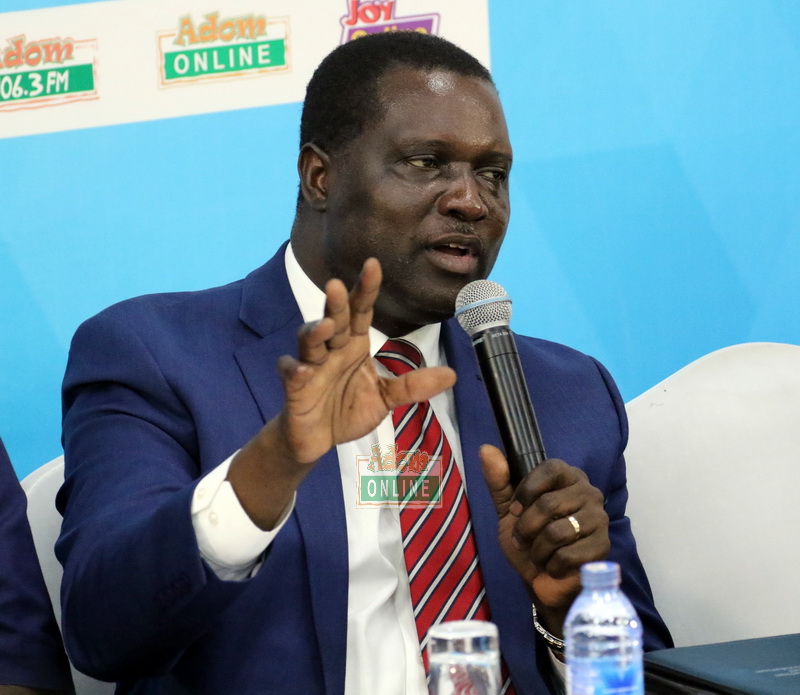


It has emerged that the Minister of Education, Dr. Yaw Osei Adutwum, presented what is suspected to be a fictitious report supposedly to convince the World Bank for the release of US$1.2million meant to execute the Ghana Accountability for Learning Outcomes Project (GALOP) 7.2B, a project he and the Ministry never executed, The Chronicle has uncovered.

The suspected made-up report was prepared through the Head, M&E Unit of the Planning, Budgeting, Monitoring and Evaluation (PBME) Division of the Ministry of Education, Bernard Ayensu.
It had the subject matter – ‘Ministry of Education, PBME Division, VERIFICATION OF PBC 7.2B’.
In the said report, Mr. Ayensu told the World Bank that the PBME had undertaken verification of GALOP PBC 7.2B, especially the number of teachers trained in using distance learning methods, and highlighted some general findings.
“On behalf of the Chief Director, I submit official notification of Government’s achievement of PBC 7.2B under the GPE COVID-19 Accelerated Funding. Also attached is the verification report on the achievement of the PBC,” noted Mr. Ayensu in his email dated Wednesday, December 1, 2021, accompanying the attached report to the World Bank.
Prof Kwasi Opoku-Amankwa, Director General, Ghana Education Service
Key among the findings was the confirmation of the development of an online learning portal by the Ministry of Education for the conduct of teacher training in integrated digital literacy. The platform, it noted, was hosted on https://katon.katechnologiesgh.com.
The PBME also confirmed the development of Digital Literacy Training Modules which had been uploaded on the platform and covers Computer Basic, Word Processing (MS Word), Spreadsheet (MS Excel), Presentation (MS POWER POINT 201.6) and Basic Internet Tutorial. These modules are completely different from what the Programme had outlined for execution.
In addition to that, the PBME told the World Bank that a total of 41,860 teachers from 685 schools across all the 260 districts of Ghana signed up for the training programme, which had both offline (via a desktop application) and online (via web application) options.
This means that a total of 58.4 teachers were trained in each of the 685 schools that benefited from the programme.The training programme, the PBME further noted, was offered in three modules, namely; Recorded Online Training; Physical Training and Online/Virtual Live Training.It also confirmed verifying the number of teachers training in integrated digital literacy.
“PBME employed a 2-stage verification strategy for PBC 7.2A. The first stage involved the generation of an automated report on teachers that have done at least one module of the Integrated Digital Literacy course.
“As of November 30, 2021 there were 40,057 teachers that had completed at least one module of the Integrated Digital Literacy course. From the automated report 40,057 teachers have completed at least one module. This exceeds the target of 40,000 teachers to be trained. PBC 7.2B has been achieved,” the made-up report prepared by the PBME in part read.
Tara E. O’Connell, Chief of Education at UNICEF Ghana Country Office
This fictitious report was prepared by the PBME under the explicit instructions of Dr. Adutwum when he realised that the deadline of the GALOP programme, which was November 30, 2021, was fast approaching.
Persons familiar with the programme say the report was developed from work done by the NTC, under the Commonwealth of Learning, as evidence for COVID-19 Digital Literacy training.
Background
In June 2020, President Akufo-Addo launched the single largest investment in Basic Education in the history of Ghana, a World Bank-funded and managed project, the Ghana Accountability for Learning Outcomes Project (GALOP).
It comprises funding from the following development partners
- International Development Association (IDA) Credit US$150m
- Global Partnership for Education (GPE) Grant US$23.9
- Global Partnership for Education (GPE) COVID-19 Grant US$14.8m
- Global Partnership for Result-Based Approaches (GPRBA) TF (EOF) US25.5m
- Government of Ghana (GoG) (EOF) US$4.5m
The US$218.7million World Bank project is being implemented by the Ministry of Education through its agencies.
The project has an original financing component (Part 1-4) and an Additional Financing (AF) component, the GPE COVID-19 Accelerated Grant for supporting COVID-19 Coordinated Education Response Plan for Ghana for Continued Learning, Recovery, and Resilience in Basic Education (Part 5).
This Part 5 made available to the Ministry of Education, a US$14.8 million grant from the GPE.
Ministry of Education building
Funding is based on Performance-Based Conditions (PBCs) which were formerly known as Disbursement Linked Results (DLRs) which allow disbursement of funds when certain agreed activities are achieved under the project. Part 5 of the project closed on November 30, 2021 at which point all PBCs were expected to have been achieved.
Per the dictates of the PBC in the GALOP AF PAD, the Integrated Digital Literacy course will be delivered through an online portal and will cover Distance Learning courses which include; in-service teacher training which will be supported to improve teacher capacity in digital literacy and the delivery of lessons through innovative platforms.
This will incorporate training of the facilitation of remote and distance learning; online and innovative tools including Zoom and WhatsApp applications, SMS, television and radio; use of smart devices in online learning platforms; remote student assessment and the LMS and Knowledge and Skills Bank.
Dr. Matthew Opoku Prempeh’s era
On the face of available records to The Chronicle, execution of the GALOP programme commenced under Dr. Matthew Opoku Prempeh, who was then the Minister of Education. During his tenure, the Ministry of Education, through its agencies, was very successful in the development and launch of the nationwide Learning Management Systems (LMS) to support distance learning for all learners, from Kindergarten to Senior High School.
The Ministry of Education was also successful in the coordinated plan to reopen schools, including nationwide back-to-school campaigns and the development of Television and Radio lessons to support learning at home.
All these, The Chronicle investigations revealed, spurred the release of US$9.2million from the GPE COVID-19 Grant to support the Ministry of Education to undertake other activities under the project.
In December 2020, a company by name TANIT was approved by the Public Procurement Authority (PPA) to design, develop and deploy a training platform with content to train a minimum of 40,000 teachers as part of a critical PBC which was to release US$1.2million.
The contract award coincided with the transition period following the Presidential and Parliamentary elections. Therefore, the execution of the project had to be put on hold upon a directive from the Chief of Staff until a substantive Minister was appointed to the Ministry of Education.
Appointment of Dr. Yaw Osei Adutwum
When Dr. Yaw Osei Adutwum, who was the then deputy Minister of Education, was subsequently appointed the substantive Minister of Education in March 2021, he, unfortunately, delayed the process related to the training for almost five months.
On July 26, 2021, Dr. Adutwum and the Ministry of Education finally signed a contract with the PPA-approved company but changed the scope of the project to only include the development of the platform and not the training.
This means that the development of content to train the targeted 40,000 teachers was excluded from the contract, raising eyebrows as to which other firm Dr. Adutwum will engage to execute this exercise.
The process, The Chronicle again uncovered, was further delayed, including a delay in the payment of Phase I of work done despite the availability of funds from the US$9.2million that had earlier on been released by the World Bank for the implementation of the project.
As the deadline of November 30, 2021, for the completion of GALOP nears, Dr. Adutwum then directed the Head, M&E Unit of the Planning, Budgeting, Monitoring and Evaluation (PBME) Division of the Ministry of Education to ‘make-up’ a report on the achievement of GALOP – P165557 PBC 7.2B.
The Minister also instructed the then Chief Director of the Ministry of Education, Benjamin Gyasi, to sign a letter addressed to the World Bank, with reference Number FA44/491/01 and subject matter ‘GHANA ACCOUNTABILITY FOR LEARNING OUTCOMES PROJECT (GALOP – P165557) ADDITIONAL FINANCING (AF) – GLOBAL PARTNERSHIP FOR EDUCATION (GPE) COVID-19 ACCELERATED FUNDING (TF OB3009): ACHIEVEMENT OF PBC 7.2B’.
The directive was heeded to by the Chief Director of the Ministry of Education who accordingly wrote the letter dated November 30, 2021 and addressed to the Task Team Leaders, GALOP, The World Bank, with the heading ‘Ghana Accountability for Learning Outcomes Project (GALOP –P165557) Additional Financing (AF) – Global Partnerships for Education (GPE) COVID-19 Accelerated Funding (TF 0B3009): Achievement of PBC 7.2B.
Attached to the letter was also the ‘Verification of the Performance Based Conditions (PBC) 7.2B’ report that was prepared by the PBME.
The letter, in part read, “The Ministry of Education has developed literacy modules and trained 40,057 teachers from 685 schools across all the 260 districts in Ghana. Training is offered via online, physical and video modes.
Resources are available to facilitate all three modes of training which allow for ongoing teacher training for digital literacy and professional development.
“In addition, digital literacy training modules have been developed and uploaded on the teacher training portal. With these deliverables, PBC 7.2B has been achieved”.
It added: “Kindly consider this letter as formal submission of evidence of achievement of PBC 7.2B under GALOP AF – GPE COVID-19 Accelerated Funding”.
The content of the attached report, serving as evidence of work for the COVID-19 Digital Literacy training by the Ministry, The Chronicle can authoritatively report, was generated out of the work done by the NTC under the Commonwealth of Learning. That means there is no evidence of work done under GALOP by the Ministry of Education and Dr. Yaw Adutwum.
The World Bank, upon receipt of the documents, submitted same to its project development partners to verify. This process was part of the agreed verification protocol for the PBC before the Bank could release the US$1.2million to the Ministry of Education.
World Bank probe for more answers
Having received the PBME report and letter from the Chief Director of the Ministry of Education, the World Bank appeared not convinced and so began to interrogate the matter further in a bid to get convincing answers.
The Chief of Education at UNICEF Ghana Country Office serving as Chair of the Development Partners, Tara E. O’Connell sent an email to the Principal Planning Officer of the PBME Division of the Ministry of Education on or about January 7, 2022, seeking among other things an explanation and other documentary evidence of the training done for the 40,057 teachers that the Ministry of Education indicated in the November 30, 2021 report.
The email asked the Ministry of Education to provide responses not later than January 14, 2021, to enable the development partners also complete its verification exercise and submit a report to the World Bank.
For instance, the Chair of the Development Partners asked the PBME Division of the Ministry of Education to explain the difference in the course content since the courses “do not seem to be the same as the training content set out under 5.1.”
The Chair of the Development Partners also asked the Ministry of Education to share the slides for the training courses, as well as examples of the self-assessments teachers, wer