


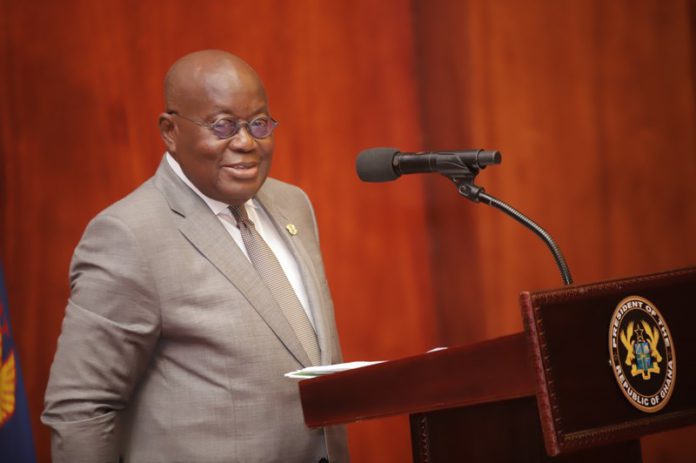
On Friday, July 1, 2022, President Akufo-Addo directed the Finance Minister, Ken Ofori-Atta, to engage the International Monetary Fund (IMF) to support Ghana’s economy.

This was contained in a statement issued by the Information Minister, Kojo Oppong Nkrumah.
Following this development, many citizens have been asking various questions about the decision. The following are answers to some of the frequently asked question’s about Ghana’s return to the IMF.
The answers were contained in a release from the Finance Ministry on Tuesday, July 5, 2022:
1. What role does the IMF play in member countries?
The International Monetary Fund (IMF) works with member countries to achieve sustainable growth and prosperity by supporting economic policies/programmes that promote financial stability and monetary cooperation, which are essential to increase productivity, job creation, and economic well-being. Currently, the IMF has a membership of 190 countries.
2. What benefits do member countries have from the IMF?
Member countries enjoy three (3) key benefits, and these are:
i. Surveillance: The IMF monitors the international monetary system and global economic developments to identify risks and recommend policies for growth and financial stability.
The Fund also undertakes a regular health check of the economic and financial policies of its 190 member countries through its annual Article IV Consultations with member countries.
In addition, the IMF identifies possible risks to the economic stability of its member countries and advises their governments on possible policy adjustments;
ii. Technical Assistance: The IMF provides technical assistance and training to governments, including central banks, finance ministries, revenue administrations, and financial sector supervisory agencies.
These capacity development efforts are centred on the IMF’s core areas of expertise ranging from taxation through central bank operations to the reporting of macroeconomic data.
Such training also helps countries tackle cross-cutting issues, such as income inequality, gender equality, corruption, and climate change; and
iii. Lending: The IMF provides loans (including emergency loans) to member countries experiencing actual or potential Balance of Payments (BOP) problems.
The aim is to help them rebuild their international reserves, stabilize their currencies, continue paying for imports, and restore conditions for strong economic growth, while correcting underlying problems.
3. Why has Ghana decided to seek support from the IMF?
Ghana is seeking IMF support for three (3) main reasons:
i. Addressing policy challenges following the Covid-19 Pandemic and the Russian and Ukraine War. The confluence of shocks from the Covid-19 pandemic and the Russian-Ukraine War have complicated the conduct of public policy globally. They have resulted in rising debt and erosion of buffers, worsening financing conditions, high inflation, and exchange rate and BOP pressures especially for Emerging Markets and Frontier Economies. As is the case in key EMs and FMs, Ghana is seeking IMF support to back its Enhanced Domestic Programme which will seek to restore stability, help to contain the rising debt, and address the emerging BOP needs;
ii. Balance of payments support: Secondly, for concessional/cheaper financing to shore up international reserves, stabilize the cedi, continue smooth payments for imports (petroleum products, pharmaceuticals, medical equipment, among others) and restore conditions for strong economic growth (including support for government flagship programmes), while correcting underlying problems; and
iii. Catalytic effect: Providing catalytic effect of accessing additional financing from third parties (friendly sovereigns/commercial creditors), including resuming ICM market access sooner than later, facilitating credit rating upgrades.
4. Are there other countries undergoing an IMF assisted recovery Programme?
African countries that have recently signed up to IMF programme include:
i. Egypt (March 2022): Egyptian government officially requested support from the IMF to help mitigate the economic fallout related to Russia’s invasion of Ukraine.
ii. Tunisia (June 2022): Tunisia has started technical discussions for an IMF intervention to restore its fiscal imbalance attributable mainly to the spillovers from the war in Ukraine, which is deepening already high economic imbalances, while creating more hardship to the population.
As a matter of fact, Kenya, Cote d’Ivoire, Rwanda, Ethiopia, Senegal, Uganda, Seychelles, Mali, Cameroon, Gabon, Equatorial Guinea, Mozambique, are among countries on the continent who are already on some form of an IMF programme, necessitated in response to economic downturn, attributable to Covid-19 and/or Russia-Ukraine War.
5. What is the Enhanced Domestic Programme?
The Enhanced Domestic Programme (EDP) is a 3-year fast-tracked macroeconomic stabilization programme that seeks to restore investor confidence and achieve fiscal and debt sustainability.
The programme is heavily driven by a mix of robust structural reforms and revenue, expenditure, and financing policies. This will further enhance the recovery and transformation efforts by the Government under the Ghana CARES ‘Obaatan pa’ Programme.
The proposed programme should span a minimum of 3 years and seeks to achieve the following objectives:
i. Strengthen Government’s effort to restore investor confidence in the economy, thereby, regaining market access, boosting Development Partner
(DP) disbursements, and unlocking other financing sources;
ii. Restore debt sustainability and macroeconomic stability to support green growth, economic transformation and job creation while protecting social spending; iii. Strengthen the Central Bank’s Monetary Policy Regime; and iv. Build buffers to strengthen resilience to economic shocks; and
v. Further enhance the recovery and transformation efforts by the Government under the Ghana CARES ‘Obaatan pa’ Programme.
6. How long will it take for the negotiations between Ghana and the IMF to be concluded?
IMF-supported programme negotiations take some time to be concluded. Depending on the availability of data to assess the macroeconomic situation, the readiness and suitability of the government’s economic programme and nature and feasibility of any prior conditions to be completed by government programme negotiations can be quick or be protracted.
Government stands ready to quicken and shorten the negotiation process by sharing relevant data as well as presenting its enhanced economic programme that will anchor the supported programme.
7. Will Ghana have to fulfil any IMF Conditionalities?
When a country seeks support from the IMF through a funded programme, its government agrees to adjust its economic policies to overcome the problems that led it to seek financial support.
These policy adjustments are conditions for IMF lending and serve to ensure the achievement of the programme’s objectives and the country’s ability to repay the IMF.
The member country has primary responsibility for selecting, designing, and implementing policies to make the IMF-supported programme successful.
This system of conditionality is designed to promote national ownership of strong and effective policies. This means that, in the case of Ghana, the conditionalities are expected to be centered around our own Enhanced Domestic Programme which the Government is committed to enforcing.
8. How much can we get from the IMF and what will the money be used for?
The total credit for an IMF-supported programme will be expressed as a percentage of the country’s quota. In the 2015 ECF programme, Ghana was granted 180% of its quota, which was equivalent to US$918mn released in equal tranches after every successful review.
In addition to the quota norms, the IMF also uses market access and other key criteria to assess the type of funding needed by a country.
This is primarily due to cost implications involved in both resources (PRGT and GRA) and how the interest cost will impact on debt sustainability, following IMF lending.
9. Does going to the IMF mean suspension of government programmes and expenditures?
NO. The member country has primary responsibility for selecting, designing, and implementing policies to make the IMF-supported programme successful.
This implies that, government programmes in line with its EDP will still go on as planned insofar as it is efficient and does not over-burden public finances.
10. Why is government going to IMF now and not earlier?
The primary conditions that necessitate an IMF-supported programme did not exist earlier. For a country to seek an IMF support, it would need to have a balance of payments challenge.
A few months ago, the conditions that pertain today and the outlook is considerably different from six months ago.
The IMF in April 2022 revised its economic forecasts and is predicting that global economic recovery from coronavirus will run into “multiple challenges” this year, warning of lower growth and higher inflation.
These were not known at the beginning of the year and were not factored in our baseline projections. Given what we know now from the data and by assessing the impact of economic growth forecast downgrades in the world’s two largest economies, China and the US, and their policy responses to the challenges, spells doom for many developing and emerging markets.
These developments have substantially changed our own assessment of the economic outlook necessitating the decision to engage the IMF for support.
This will help us considerably to weather an impending economic storm.
11. Will government terminate the E-levy because IMF will give Ghana money?
NO. The IMF lending to Ghana will be for balance of payments support (i.e. to shore up the international reserves).
Government is committed to ensuring the smooth operationalisation of all taxes including the e-levy to ensure that in addition to the IMF’s resources, government can continue to support its developmental goals on its own while ensuring that tax-to-GPD ratio increases to the peer range of 16%-18%.
An IMF-supported programme is likely to encourage the government to investigate the factors hindering the success of the e-levy (including by providing technical assistance if needed) and come out with strategies to improve it.
Additionally, other tax measures could be considered for the medium-term.
12. Is Ghana facing a crisis?
The whole world, including Ghana, is facing significant policy challenges, although each country is at a different stage (countries like Ghana are at an early stage while countries like Sri Lanka have a fully blown economic crises).
To quote the IMF Managing Director “To put it simply: we are facing a crisis on top of a crisis. First, the pandemic: it turned our lives and economies upside down— and it is not over.
The continued spread of the virus could give rise to even more contagious or worse, more lethal variants, prompting further disruptions—and further divergence between rich and poor countries.
Second, the war: Russia’s invasion of Ukraine, devastating for the Ukrainian economy, is sending shockwaves throughout the globe”.
13. At what stage is Ghana’s economic crisis?
Ghana’s economy is facing external shocks emanating from the scarring effect of the COVID-19 pandemic and the Russian-Ukraine war resulting in:
i. High and rising inflation. Imported inflation passthrough because of supply chain disruptions which has increased the cost of raw materials (including fertilizer, refined oil products and metals) needed for production astronomically across the globe.