


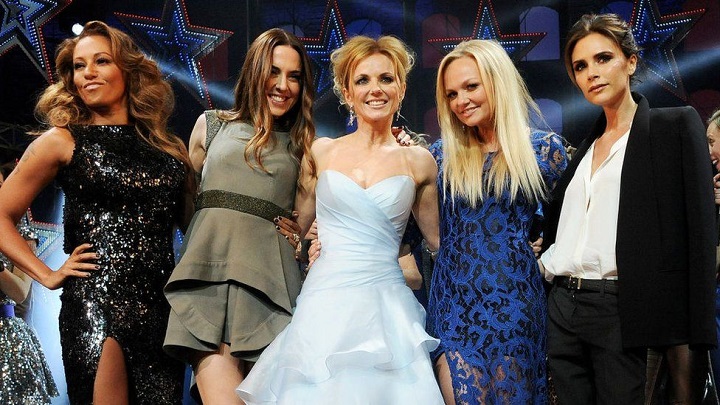

It came out of nowhere. It changed the course of pop music. It was Wannabe – the scrappily brilliant debut single by The Spice Girls.
The record label had been worried. Wannabe was too weird, too anarchic. They hated the video. BBC Radio 1 was refusing to play it. Breakfast show DJ Chris Evans told the band to go back to kids’ TV.
But the girls knew better. “It’s not negotiable as far as we’re concerned,” they insisted. “Wannabe is our first single.”
And “if they decided they wanted to do something, then that’s what was going to happen,” Wannabe‘s co-writer Richard “Biff” Stannard told the BBC.
History proved them right.
Released 25 years ago, on 8 July 1996, Wannabe spent seven weeks at number one in the UK and four in the US. In the process, it made five unknown girls – Victoria Caroline Adams, Melanie Janine Brown, Emma Lee Bunton, Melanie Jayne Chisholm and Geraldine Estelle Halliwell – global superstars.
Here’s a story from A to Z of how the band started, rose to fame, fell apart and put themselves back together again. So grab a cup of tea, slam your body down, wind it all around, and we’ll begin.
A is for Auditions

The advert that started it all, from The Stage in 1994
On 4 March 1994, 400 aspiring singers crammed into London’s Dancework Studios after spotting an advert for a new girl band in The Stage newspaper.
They were split into groups of 10 and taught a dance a routine to Eternal’s Stay. Afterwards, they each performed a solo song to father-and-son management team Bob and Chris Herbert.
Mel B blew them away, singing Whitney’s The Greatest Love Of All, while Mel C went for The Pointer Sisters’ I’m So Excited and Victoria chose Mein Herr from Cabaret.
A month later, they were invited back for a second audition – now with only 10 girls. Geri was there too, even though she had skipped the initial audition after getting sunburnt in Spain. “She just said she was ill and pleaded to be fast-tracked to the recall,” Victoria later recalled.
All four were selected to form the band alongside 17-year-old Michelle Stephenson – “the sort of girl you can imagine in a Flake advert”, said Victoria – who had received the highest scores at the audition.
The quintet moved in to a house in Maidenhead, where they received dance and vocal coaching, but it soon became clear Michelle didn’t fit in.
Eventually, Michelle was replaced by Emma Bunton – a former stage school pupil who had been recommended by their vocal tutor, Pepi Lemer.
“Of course I regret I’m not a multi-millionaire like them,” Michelle later told The Mirror. “But at the time I left the group I knew I was doing the right thing. It wasn’t my kind of music and they were not living the lifestyle I wanted.”
B is for Break-ins and Blow-up dolls

The band formed a close bond while sharing a house in Maidenhead
After months of rehearsals, the five girls grew disillusioned with Bob and Chris Herbert, and decided to extricate themselves.
They hadn’t signed a contract – but their managers did have the master recording of their songs Wannabe and 2 Become 1. So Geri hatched a plan to retrieve the recordings and make off with them.
“I don’t know how she actually managed to get it – everything was so Bonnie and Clyde,” says Victoria in her autobiography, Learning To Fly. “She had it hidden in her knickers, she said, in case Bob and Chris had given chase.”
Working from the back of Geri’s beaten-up Fiat Uno, the band started building a new team, eventually signing with Annie Lennox’s manager Simon Fuller. He immediately put them in the studio, and started introducing them to record labels.
“I’ll never forget the day they burst in here,” Virgin Records deputy director Ashley Newton told Music Week in the first-ever profile of the Spice Girls. “They caused such a commotion, doing a mad routine in the office, all talking at once and being really funny.”
He called his bosses and told them: “You have to see this.”
On the day they were due to sign to the label, the band sent five Ann Summers blow-up dolls in their place, with a chauffeur instructed to announce that the Spice Girls had arrived.
“There were almost heart attacks,” Geri claimed.
“If Virgin didn’t know who yet they were dealing with, they did now,” added Victoria.
Later, after they actually turned up and signed their contracts, the band threw the dolls into the Grand Union Canal, where they bobbed about for days.
C is for Charts

Wannabe won single of the year at the 1997 Brit Awards
Although Virgin was sceptical of Wannabe‘s potential, it was an instant smash, selling 73,000 copies in its first week.
Hoping it would go to number one, the band crowded around a radio on a picnic rug in Geri’s sister’s garden, champagne at the ready, as the countdown was revealed.
But their hopes were dashed: Wannabe entered the charts at number three, held at bay Gary Barlow’s Forever Love (his only solo number one) and the Fugees’ Killing Me Softly.
However, the following week it climbed to the top spot, becoming the first of six consecutive number ones for the band.
D is for Demo tape

Despite the “manufactured” tag, the band had writing credits on all their songs
The original demo for Wannabe is being released to mark the song’s 25th anniversary – and it’s a very different experience to the final version, full of record scratches, clunky 1990s synths and a bizarre breakbeat outro.
The song was something of a Frankenstein’s monster, co-writer Matt Rowe told David Sinclair for his 2004 Spice Girls biography.
“They made all these different bits up,” Rowe said. “Not thinking in terms of chorus, bridge or what was going to go where – just coming up with all these sections of chanting and rapping and singing. And then we just sewed it together. Kind of a cut-and-paste method.”
Virgin, noting the popularity of girl bands like Eternal and TLC, were keen to give the song an R&B makeover and sent it to US producer Dave Way to be remixed. The result, according to Halliwell, “was bloody awful”.
Eventually, Mark “Spike” Stent – a producer who had worked with Massive Attack and Madonna – was called in to knock the song into shape.
“The problem was that the vocal balance hadn’t been quite sussed,” he told Sound On Sound magazine in 1999. “It’s a very quirky pop record, and there’s not a lot going on with it, and my work was all about getting the vocals to sound right. It was quite tough to do, even though it only took six hours.”
E is for Equality

The band’s early shows were irresistibly raucous
The Spice Girls have always had a loyal LGBTQ following, and even changed the lyrics to one of their biggest hits to recognise their support.
The original version of 2 Become 1, as featured on their debut album Spice, contains the lyric: “Any deal that we endeavour / Boys and girls feel good together”.
But by the time it came out as a single in December 1996, the line had been changed to: “Once again if we endeavour/Love will bring us back together”.
In an interview with Gay Times, Emma Bunton said the alteration was in recognition of their LGBTQ fans.
“We changed the lyrics in a hotel,” she recalled. “We were travelling and we were like, ‘Absolutely, it needs to be changed.’ We felt like it needed to be more inclusive.”
F is for First impressions
The Spice Girls were the prototypical manufactured band – and when they were first put together, they couldn’t help sizing each other up.
“I thought Emma was a softie, Vicky was a snob and Geri was a real loudmouth,” wrote Mel B in the band’s 1997 book Girl Power.
Emma, Victoria and Mel C all declared Geri a “complete nutter”, recalling: “She had her hair in bunches and was wearing a pink fluffy jumper and saying, ‘Look, look – I’m a duck!'”
Geri, meanwhile, “couldn’t stop staring at Emma – she was really fresh and pretty with a big smile like a doll’s”.
G is for Girl Power

The band had number one hits in more than 40 countries worldwide
Girl Power came in for a lot of stick – mostly from critics who weren’t girls and didn’t need any more power, music writer Tom Ewing observed.
Geri was the one who pushed the concept, and even developed a “power oath” to be recited when events demanded: “I, being of sound mind and new Wonderbra do solemnly promise to cheer and dance and zig-a-zig-ah. Ariba! Girl Power!”
But even if the parameters were a little hazy, the idea was potent. The Spice Girls stood for freedom, self-belief and disobedience – and they inspired generations to stick up for themselves.
In 2017, Geri reflected on the legacy of Girl Power in a BBC interview: “Twenty years ago, if you said the word feminism, you thought of those bra-burning, marching protestors. It was quite tough and harsh.
“For me, Girl Power was a much more punchy way of saying it. But actually, Girl Power embodies much more than a gender. It’s about everybody. Everybody deserves the same treatment, whatever race you are, gender you are, age you are.
“It was just saying that in a very digestible way.”
H is for Homesickness
As the Spice Girls became a global phenomenon, they were whisked away from their friends and family for months at a time. For tax reasons, they even spent 1998 living outside the UK, which exacerbated their feelings of isolation.
“I cry every day because I want to go home,” wrote Victoria in the 1998 book Forever Spice.
“I called home the other day and my mum said, ‘Your sister has just come in with the baby!’ I could hear baby noises and… EastEnders on the TV in the background and then my dad came in from the chip shop with everybody’s dinner. I was here on my own.
“OK, we’re famous and we’re doing what we enjoy but all I was thinking at that time was, ‘God I miss my family and home!’ I miss seeing the windows all steamy when my mum has burnt the dinner and there’s a chair wedging the door open so that the fire alarm doesn’t go off.
“I have been strong for a long time and you always think to yourself, come on, let’s be strong, move on. But I don’t want to be strong any more. I just want to sit down and cry… and have someone stand in front of me with their shield and say, ‘I’ll protect you’.”
I is for Istanbul

The band’s tours made more than $60m
The Spice Girls performed their first ever concert at an 8,000-capacity basketball arena in Istanbul, Turkey, on 12 October 1997.
Why Turkey? One popular theory said they had chosen it to get as far away from the UK as possible, afraid the British press would savage their stage debut. But the reality was more prosaic. Pepsi was sponsoring the tour, and they insisted on launching it in a country where Pepsi outsold Coca-Cola.
The soft drink deal was hammered home at a press conference the day before the show. “Posh, will you marry David Beckham?” asked one reporter. “That’s none of your business,” she replied. “But he drinks Pepsi.”
The concert itself was “the sort of pop show they don’t do anymore”, said The Guardian, full of pyrotechnics, slick choreography, and even a miniature roller coaster. And yes, the review added, “they really sang”.
The Sun was more cautious, calling the gig “competent and capable” with “plenty of room for improvement”.
J is for Journalists in Jeopardy
Part of the Spice Girls’ appeal was their absolute refusal to play along with the media. Interviewing the band was like being dragged into a Top Shop dressing room by a hen party on its third day. They suffered no fools, and took no prisoners.
“They weren’t star-struck. They brought everyone around them to their level,” their PR Nicki Chapman once said.
For example: When the Spices announced their first reunion tour in 2007, one hapless journalist asked if the band were “unfit to do the dance routines” after having children.
“You don’t look very fit yourself,” shouted Mel B, before climbing off the stage and unbuttoning his shirt to check for a six-pack.
But the absolute gold standard, wheels-falling-off-and-car-crashing-into-a-ditch Spice Girls interview was conducted by Jamie Theakston in 1997.
&